

What if the highest valuation isn’t the best advice for your sale? When you’re deciding how to choose an estate agent to sell your home, a confident figure can be tempting, but it needs to be supported by local knowledge and a clear plan. You also need to know who’ll handle your sale once you’ve signed up.
It’s understandable to feel unsure. Agents can differ in their marketing, communication and sales progression, whilst fees and contract terms can be hard to compare at a glance. Look beyond the headline valuation and weigh up the evidence behind it.
This checklist will help you compare agents fairly. You’ll learn what to look for in a valuation, which questions to ask about service and terms, and how to assess the person guiding your sale. The aim is to choose support that feels clear, locally informed and consistent from valuation through to completion. At FSG Estate Agent, founder Fran works directly with clients throughout that process.
Key Takeaways
- Set your priorities first, so you can judge which service best fits your move.
- Look for comparable evidence and local context behind a valuation, not just the figure itself.
- Compare marketing, viewings, communication and sales progression on a like-for-like basis.
- Before you choose an estate agent to sell, read the fee basis and contract terms, including how the agreement can end.
- Use a shortlist and evidence notes to make a considered choice, then look for support that continues through each stage of the sale.
Choosing an estate agent to sell: decide what matters for your move
Choosing an agent can feel difficult when the promises sound alike. One may focus on a bold valuation, another on marketing, and another on personal support. A confident pitch alone won’t show whether the advice fits your property or how you want your sale handled.
Start with your priorities. Are you looking for a realistic view of your home’s potential, regular updates, professional marketing, or someone who will stay involved as the sale progresses? These needs can overlap, but deciding what matters most helps you compare agents on more than presentation.
Start with your sale priorities, not the sales pitch
Before comparing agents, write down your preferred timescale, the communication style that suits you and the concerns you most want addressed. You may be flexible about when you move but want one consistent point of contact. Or you may value clear pricing advice because you don’t want to plan around an unsupported asking price.
Separate must-haves from preferences. A must-have might be straightforward updates; a preference might be a particular marketing approach. This gives you a practical way to judge whether an agent’s service matches your needs, rather than being swayed by whichever promise sounds most appealing.
A suitable estate agent is one whose evidence and service match your priorities. The advice should have a clear rationale, and the support on offer should address what matters to you. That doesn’t mean choosing the agent who agrees with every expectation or makes the most confident prediction.
- Must-haves: the essentials you need to feel informed and supported.
- Preferences: useful features you’d welcome, but could compromise on.
- Main concerns: the parts of the sale you most want help managing.
This simple exercise keeps the decision grounded. If your main concern is feeling left out of the loop, for instance, clear, personal communication may matter more than an impressive-sounding marketing promise. If you’re unsure how to weigh your priorities, start with what would make the sale feel manageable.
What should a seller expect from an estate agent?
An estate agent helps present a home to potential buyers, advises on its sale and supports the seller as interest develops. For a general explanation of the role in the UK, see What is an estate agent? The details of the service can differ, so it’s important to understand what’s included.
Advice should be understandable and relevant to your property, circumstances and priorities. You should be able to follow the reasoning, not just hear a conclusion. As you compare options, look at three things: the evidence behind the advice, the service you’ll receive and whether the working relationship feels right. The next sections explore each in turn.
Assess an estate agent’s valuation and local knowledge
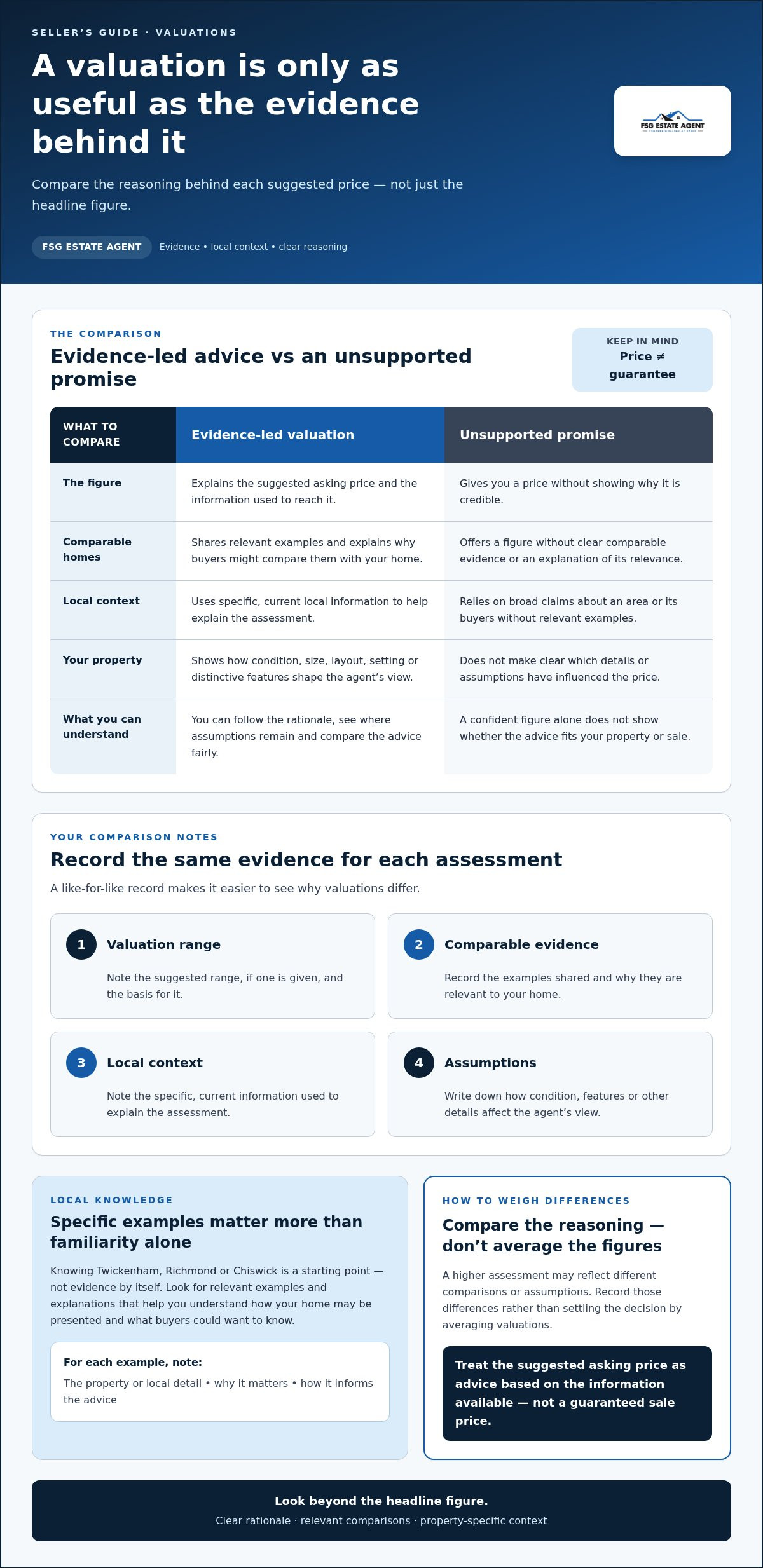
A valuation is useful when you can see how the agent arrived at it. Don’t choose an agent simply because they suggest the highest asking price. A figure without clear reasoning can make it harder to set realistic expectations and plan your next move.
An evidence-led valuation explains how the property compares with relevant local homes; an unsupported promise gives you a price without showing why it’s credible. Treat the suggested asking price as advice based on the information available, not a guaranteed sale price. To compare agents fairly, record the reasoning behind each assessment using the same criteria.
Look for evidence behind the suggested asking price
Ask whether the examples reflect properties a buyer might genuinely compare with yours. Note each property’s location, type, size, condition and features, then record why the agent considers it relevant. A nearby home may still be a poor comparison if its layout, condition or setting differs substantially.
Condition and distinctive features can influence an assessment, as can the market context at the time. A clear explanation should show which details have shaped the agent’s view and where assumptions remain. Use this record to compare the reasoning, not just the final figure:
| What to record | What to look for |
|---|---|
| Valuation range | The suggested range, if one is given, and the basis for it. |
| Comparable evidence | Examples shared and the reasons they are relevant to your home. |
| Local context | Specific, current information that helps explain the assessment. |
| Assumptions | How condition, features or other details affect the agent’s view. |
This makes differences easier to understand. One assessment may be higher because it uses different comparisons or assumptions. Note those differences rather than trying to settle the decision by averaging figures. GOV.UK also provides official guidance on choosing an estate agent, including points to consider when using an agent.
What useful local knowledge looks like
Local knowledge should help you understand how your home may be presented and what buyers could want to know. Familiarity with Twickenham, Richmond or Chiswick is a starting point, not evidence by itself. Look for relevant examples and explanations, rather than broad claims about an area or its buyers.
Record the property or local detail the agent refers to, why it matters and how it informs their advice. For instance, they might explain why a particular comparable is useful or identify a feature of your home that should be clear in its marketing. Include only examples the agent has actually provided.
That record gives you something concrete to compare when you choose an estate agent to sell. For a local perspective on your property, arrange a complimentary property valuation with FSG Estate Agent.
Compare estate agent marketing, fees and service terms fairly
Once you’ve assessed the advice, compare what each agent will actually do. A lower headline fee doesn’t tell you whether the service includes the support you value or whether extra charges may apply. A fair comparison checks both the fee and the work included in the agreement.
Use the same headings for every proposal. Record what’s clearly included, what’s described vaguely and what isn’t covered in the information you’ve received. This turns different sales presentations into a practical comparison without assuming that similar phrases mean identical services.
| Service area | What to compare |
|---|---|
| Marketing | Which marketing activities are included, and what the proposal says will be prepared for your property. |
| Viewings | How viewing arrangements are described and who is expected to handle them. |
| Communication | How updates are provided, who your main contact is and how progress is shared. |
| Sales progression | What support is described after an offer, including how progress is followed up. |
Compare the work included, not just the headline fee
For marketing, note the activities named in the proposal without getting distracted by a long list of tactics. The important comparison is whether the plan is clear and relevant to your home. A separate marketing guide can explore individual methods in more detail; here, focus on what each agent says is part of the service.
Then compare the fee on a like-for-like basis. Check whether it’s a percentage or fixed amount, whether VAT is included, when it becomes payable and whether the agreement mentions additional charges. A lower figure may cover a different scope of work, so understand what sits behind it before comparing.
Read the agreement before you instruct an agent
Before signing, read the written terms. Look for the fee basis, agreement period, notice requirements and provisions for ending the arrangement. Check how the contract describes sole agency and multiple agency. Broadly, these relate to whether one agent or more than one is appointed, but the wording and fee implications depend on the agreement.
Pay particular attention to how the agreement defines the agent’s rights and when a fee may be due. Don’t rely on a verbal summary if the written wording says something different. If a phrase is unclear, have it explained in plain English before you sign, and make sure any changes are recorded in writing.
Keep your comparison notes with the proposals and agreement. They’ll help you see whether the fee, promised work and contract terms fit together, rather than leading you to choose on one attractive detail alone. That gives you a clearer basis to choose an estate agent to sell with confidence in the service you’re agreeing to.
Use a shortlist checklist to make your estate agent decision
You’ve gathered the details. Now put them into a format that makes the choice easier to see. A shortlist keeps the decision focused on your priorities, rather than whoever made the strongest first impression. Use the same checklist for each agent and keep evidence notes beside your assessment.
Build a shortlist using consistent criteria
Begin with agents active in your area and experienced with your kind of property. Keep the shortlist small enough to compare properly. For each agent, record the valuation reasoning, the service described, how communication will work and the key agreement terms. Online ratings may help you form an initial impression, but they’re only one source of information. Your notes should capture what the agent has explained directly.
Work through these steps:
- Define your priorities. Write down your must-haves, preferences and main concerns about the move.
- Create a shortlist. Focus on agents active in your area and relevant to your property type.
- Compare the evidence. Note the reasons behind each valuation and the specific service described.
- Review the terms. Record the fee basis, agreement period and how the contract can end.
- Decide against your priorities. Choose the option whose evidence and service best fit what you need.
A simple scorecard can help organise your thinking. Give each area a rating such as “strong fit”, “unclear” or “needs follow-up”, then add a short note explaining why. For example, record what supports a valuation or what the proposal says about updates. These labels are prompts for reflection, not a scientific score or a substitute for your judgement.
| Area to compare | Your assessment | Evidence or note |
|---|---|---|
| Local knowledge and valuation | Strong fit / unclear / follow-up | Specific reasoning shared |
| Service and communication | Strong fit / unclear / follow-up | What is included and who stays in touch |
| Agreement terms | Clear / unclear / follow-up | Fee basis and relevant contract wording |
Make the final choice with confidence
Before you decide, pause. Could you explain what the agent will do, how you’ll receive updates and what you’re agreeing to? Do you feel listened to, and is the advice clear enough to weigh up? If anything remains uncertain, note it rather than letting urgency or a high valuation settle the decision.
Use the priorities you set at the start as your final test. If questions remain, the accompanying guide to questions to ask an estate agent can help you prepare for a further conversation. Choose an estate agent to sell your home based on fit, not pressure. If you’re selling in Twickenham, Richmond or Chiswick, arrange a complimentary property valuation with FSG Estate Agent as a practical next step.
How FSG supports sellers from valuation to completion
A useful way to assess an estate agent is to look at how its service works in practice. FSG Estate Agent provides residential sales support in Twickenham, Richmond and Chiswick, from valuation and marketing through negotiation and sales progression to completion. The service combines local knowledge and personal involvement, keeping advice and support connected as your sale moves forward.
Personal contact and clear responsibility
Founder Fran works directly with clients throughout the sale process. You have a consistent person to speak with, rather than being left unsure who is responsible for your sale. Direct contact can also keep communication clear: you can discuss advice, understand what’s happening and know who is handling the next step. The focus is attentive support, not promises about a particular price or completion date.
Continuity matters because selling a home involves decisions at different points. The person who understands your priorities from the valuation can carry that context into the marketing, buyer negotiations and sales progression. FSG’s support includes professional property marketing, negotiation with buyers and proactive follow-up as the sale progresses. Each part contributes to a joined-up experience, whilst the outcome and timing remain specific to each sale.
When you choose an estate agent to sell your home, consider who will stay involved after the initial valuation. A clear personal relationship can help you feel informed and supported when you need an explanation or update. It also gives you a direct line to the person who knows your property and the discussions around its sale.
A straightforward next step for sellers
FSG’s local residential sales service covers Twickenham, Richmond and Chiswick. It begins with a complimentary, no-obligation property valuation from a local specialist. The valuation can help you understand the agent’s view of your home and start a conversation about how it could be marketed. From there, Fran provides personal support through the sale, including marketing, buyer negotiation and proactive sales progression.
Use that first conversation to consider whether the advice is clear, the service fits your priorities and you feel comfortable with the person guiding the process. Take time to understand the proposed support and how it relates to your plans.
If you’re preparing to sell in Twickenham, Richmond or Chiswick, arrange a complimentary, no-obligation valuation and discuss your sale with Fran.
Take your next step with confidence
The right choice should leave you clear about what happens next, not pressured to decide before you’re ready. As you prepare to choose an estate agent to sell your home, think about what you want from the first conversation: a clearer view of your options, guidance on presenting your property, or a chance to see whether the working relationship feels right.
You don’t need every detail settled before you begin. A conversation can help you consider your plans and decide on a sensible next step. With FSG, founder Fran works directly with clients through the sale, supported by professional marketing and proactive sales progression. You can explore your property’s value without an obligation to proceed.
Arrange a complimentary, no-obligation property valuation with a local property specialist. It’s a straightforward way to start a conversation about your sale and the support you need. Take the time you need, make the decision that suits your move, and begin with confidence.
Frequently Asked Questions
Is the highest estate agent valuation always the best one to choose?
No. A higher suggested asking price doesn’t guarantee that a buyer will offer that amount. Before you choose an estate agent to sell your home, ask how the asking price will be reviewed if buyer response differs from expectations. A useful discussion should cover how viewing feedback will be shared and what changes in interest might prompt a fresh conversation about your approach.
How many estate agents should I compare before choosing one?
There’s no fixed number that suits every sale. Compare enough agents to see meaningful differences in advice, service and terms, whilst leaving yourself time to examine each proposal properly. A smaller, well-considered comparison is more useful than collecting lots of valuations without recording their reasoning. If two proposals seem similar, note what still needs clarifying before deciding whether to add another agent to your comparison.
Can I change estate agents if I have already signed an agreement?
Possibly, but the agreement will determine the steps and any fee implications. Read the clauses on the term, notice and ending the arrangement, and check whether a fee could still be due after the agreement ends. Don’t assume that instructing a new agent cancels the first contract. If the wording is unclear, ask for it to be explained in writing before taking action.
What does sole agency mean when selling a property?
Sole agency generally means you appoint one agent to market your home during the agreed period. Multiple agency means more than one agent is appointed, usually under different fee terms. Check the exact agreement, especially the distinction between sole agency and sole selling rights. Under sole selling rights, a fee may be due even if you find the buyer yourself, so understand the wording before signing.
Do estate agents need professional qualifications in the UK?
There isn’t currently a general mandatory qualification requirement for estate agents across the UK. The government’s home buying and selling reform programme includes a planned consultation on mandatory qualifications in 2027-28, but that isn’t the same as a requirement already being in force. If qualifications matter to your decision, ask what relevant training and experience the person handling your sale has, and consider how clearly they explain their advice.
Should I choose an online estate agent or a local estate agent?
Choose the service that best fits the support you want and the way you prefer to work. Online agents often use fixed fees, which may be payable upfront whether or not the property sells. A local agent may offer direct knowledge of the area and more personal involvement. For a home in Twickenham, Richmond or Chiswick, consider whether local insight and an ongoing personal relationship matter to you.
How long should I give an estate agent to sell my home?
There’s no reliable fixed period, because buyer interest and the time a sale takes can vary. Agree when you’ll review progress, then look at enquiries, viewing feedback and any offers together. If activity is limited, discuss whether the marketing, asking price or presentation needs reconsidering. Also check your agreement’s duration and notice terms, so you know when you can review the arrangement or make a change.


