

Has your buyer made an offer, so the hard part is over? Not quite. An accepted offer is an important step, but it doesn’t guarantee the sale will reach completion. If you’re looking for an estate agent from valuation to completion, you’ll want to know what happens at each stage. The role goes beyond arranging viewings: clear communication and follow-up matter at every handover.
It’s natural to be unsure what happens next, who is responsible for each task and how to spot delays early. This guide explains the stages of a UK home sale, what you need to do as the seller and how your estate agent, conveyancer, buyer and lender fit into the process.
From the initial valuation and marketing to negotiating an offer and progressing the sale, you’ll see what to expect before the keys are handed over. At FSG Estate Agent, founder Fran works directly with clients, helping clarify updates and next steps. Proactive follow-up can help keep things moving, although no agent can guarantee a completion date.
Key Takeaways
- See how an estate agent from valuation to completion helps guide a sale through pricing, marketing, negotiation and progression.
- Understand why accepting an offer is a step forward, not a guarantee that the sale will complete.
- Get a clearer sense of how you, your estate agent, conveyancer, buyer and lender each contribute to the process.
- Use prompt replies, organised documents and agreed updates to help keep your sale moving.
- Learn how one point of contact can make responsibilities and progress easier to follow.
Estate agent from valuation to completion: the stages of a home sale
An estate agent guides the sale from assessing your home and finding buyers to negotiating an offer and following progress towards completion. The agent manages marketing and buyer communication, while your conveyancer handles the legal work. Knowing who is responsible for each task makes handovers clearer. For a broader overview of the role, see Estate agent.
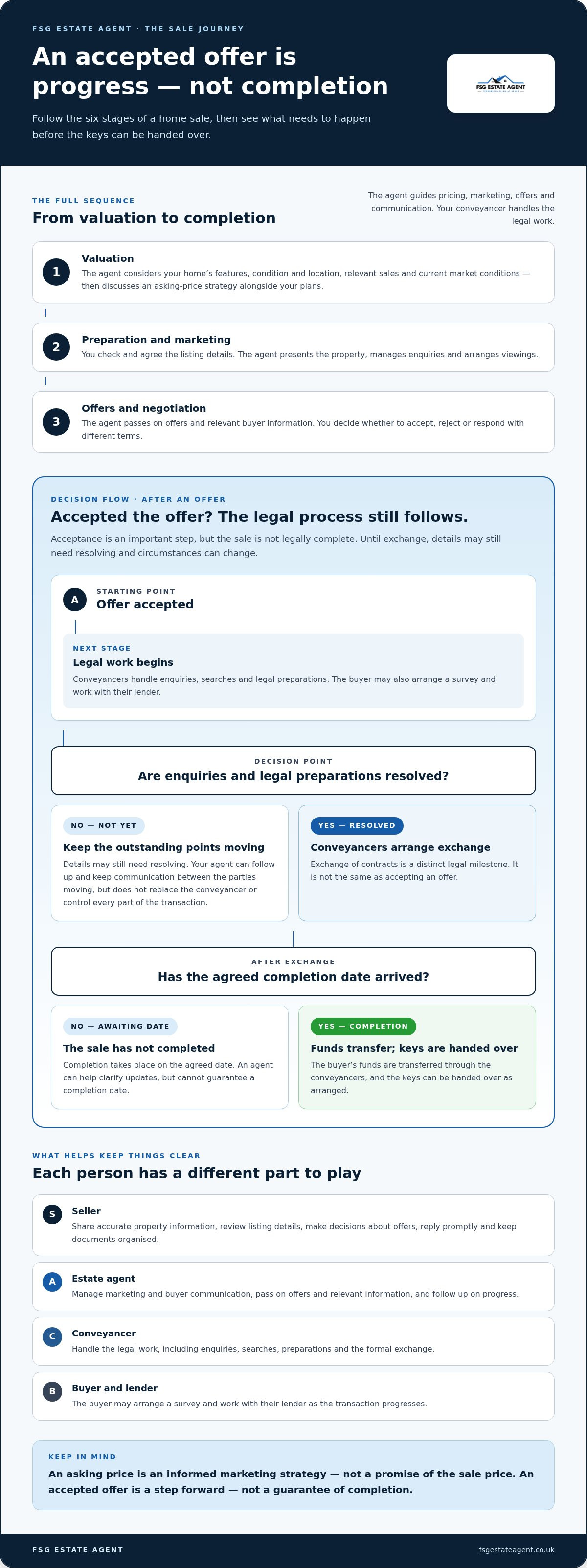
Here’s the usual sequence for a residential sale in England and Wales:
- Valuation: The agent assesses your property and discusses a suitable asking-price strategy alongside your plans.
- Preparation and marketing: You agree the listing details, then the agent presents the property to potential buyers and arranges viewings.
- Offers and negotiation: The agent passes on offers and relevant buyer information so you can decide how to respond.
- Legal work: Once an offer is accepted, conveyancers handle enquiries, searches and legal preparations. The buyer may also arrange a survey and work with their lender.
- Exchange of contracts: The conveyancers arrange the formal exchange. This is a distinct legal milestone, not the same as accepting an offer.
- Completion: The sale completes on the agreed date. The buyer’s funds are transferred through the conveyancers, and the keys can be handed over as arranged.
An accepted offer is progress, not a guarantee of completion. Until exchange, details may still need resolving and circumstances can change. Your agent can keep communication between the parties moving, but doesn’t replace the conveyancer or control every part of the transaction.
What happens at a property valuation?
A local agent considers the home’s features, condition and location, then compares it with relevant sales and current market conditions. In Twickenham, Richmond and Chiswick, local knowledge can help explain how different streets, property types and buyer demand may affect a pricing discussion. A market valuation is an informed view to help set an asking price, not a promise that a buyer will pay that amount.
The valuation is also a chance to explain your aims, such as your preferred moving plans or any practical considerations. You can discuss likely next steps, including preparation, marketing and how offers will be handled. This gives you a clearer basis for deciding whether and when to proceed.
How does a home move from listing to an offer?
Before launch, review the property details with your agent and identify any straightforward preparation that may help buyers understand the home. Once listed, the agent manages enquiries, arranges viewings and shares feedback. That feedback can show what viewers value, what they’re unsure about and whether any details need clarifying. Use it to consider changes to the presentation or your approach to offers.
There’s no fixed timetable for buyer interest. The response depends on the property, its asking price and market conditions. An estate agent from valuation to completion can explain each step and follow up on outstanding conversations, while keeping your decisions and responsibilities clear.
From valuation to offer: pricing, marketing and viewings
Once you’ve agreed to bring your home to market, the asking price and presentation shape who enquires and what they expect to see. A considered approach is not about chasing the highest possible figure on paper. It’s about positioning the property clearly for buyers likely to see its value, while giving you room to assess genuine interest and offers.
An asking price is a marketing strategy, not a promised sale price. Buyer response depends on the home, its presentation and the market at the time. Your agent can explain the reasoning behind the recommended price and review the response with you. If enquiries are quiet or feedback points to a concern, discuss whether to adjust the approach. One comment alone may not be a reason to change the price; look for useful patterns in the feedback.
How does the agent prepare a property for marketing?
Before launch, make sure the property details are accurate. Share relevant information about the home and check the listing carefully, including its layout, features and details that could affect a buyer’s understanding. The agent can then prepare professional marketing materials that present the property clearly. A well-considered listing helps buyers decide whether a viewing is right for them. You can explore the planned property marketing guide for more on those details.
Accurate information supports better conversations. If a buyer asks about something in the listing, a clear answer can help them decide whether to proceed. Tell your agent promptly if you spot an error or something about the property changes after the listing goes live. Clear details help set fair expectations from the first enquiry.
What should sellers do when offers arrive?
An offer is an opportunity to review your options, not a decision you need to make without context. Consider how it fits your plans and circumstances, including whether you’re part of a property chain. Your agent should communicate the offer and relevant information about the buyer, then discuss negotiation with you. The choice to accept, reject or respond with different terms remains yours. The planned offer and negotiation guide can cover that decision in more depth.
Viewings also provide useful signals. Ask for clear feedback after appointments, then consider what it suggests about the price, presentation or information buyers need. A recurring question may point to a detail worth clarifying. Positive interest without an offer may be a reason to discuss what buyers are weighing up. Your agent can relay those responses and help you decide on a practical next step, rather than leaving you to guess what happened.
Regular updates help you stay involved and make informed choices, from the first listing decision to responding to an offer. If you’re preparing to sell in Twickenham, Richmond or Chiswick, you can discuss a property valuation and the approach that fits your home and plans.
After an offer is accepted: why the sale is not complete
An accepted offer is an important step, but it doesn’t complete the sale. In England and Wales, the sale generally becomes legally binding when contracts are exchanged, not when you agree an offer. Before then, legal checks, buyer enquiries and practical arrangements still need attention. Some transactions progress smoothly; others need further information or decisions before they can move on.
Several people have distinct responsibilities during this stage:
- Your conveyancer handles the legal work, reviews documents and communicates with the buyer’s conveyancer.
- You, as the seller, provide requested information and replies, and make decisions when questions or issues arise.
- The buyer may arrange a survey, raise enquiries and work through their purchase arrangements.
- The lender, if there is a mortgage, assesses the buyer’s application and property as part of its lending process.
These steps can overlap. A survey finding might lead to a question or further discussion, but it doesn’t automatically mean there’s a problem. Delays can also arise if information is incomplete or someone is waiting for a response. Prompt, clear replies help the relevant people understand what’s needed next.
What happens during conveyancing?
Conveyancers manage the legal transfer and the formal work needed to prepare for exchange and completion. They review property information and raise enquiries with the other side. Your replies, supporting documents and any further clarification can affect how quickly those points are resolved. If you’re unsure what a legal question means or how to answer it, discuss it with your conveyancer, who is responsible for that advice.
Good coordination matters alongside the legal work. As your estate agent from valuation to completion, FSG supports sales progression by keeping in touch with the parties, following up on outstanding points and making next steps easier to see. This support doesn’t replace conveyancing. It helps maintain communication so you can see what is progressing and where a reply or update may be needed.
What is the difference between exchange and completion?
Exchange of contracts is when the agreed sale becomes legally binding; completion is when the transaction is finalised, the money is transferred and the keys are handed over as arranged. In England and Wales, these are separate milestones. Your conveyancer confirms the arrangements and dates with you. The gap between exchange and completion can vary, so don’t assume a standard timescale applies to every sale.
Until exchange, stay responsive and tell your agent and conveyancer if your circumstances change or a concern comes up. After exchange, follow the completion arrangements agreed through your conveyancer, including plans for moving and key handover. Your agent can help keep communication moving, but cannot guarantee that every transaction will reach completion on a particular date. Clear responsibility for each query makes it easier to spot what needs attention, without confusing progress support with legal advice.
How sellers can help keep an estate-agent-led sale moving
Your estate agent can follow up with buyers and keep you informed, but you also have a part to play. Prompt replies, organised paperwork and early conversations make it easier for everyone to see what’s needed next. These steps can’t prevent every delay or guarantee a sale, but they can reduce avoidable waiting and help you make decisions with better information.
Which seller actions can prevent avoidable delays?
Keep relevant property information and documents together, and respond to requests from your conveyancer or agent as soon as you reasonably can. If you need time to find something, say so and agree when you’ll follow up. Tell both your conveyancer and estate agent about material changes, such as a change to your moving plans or an issue that could affect the property. Early notice gives them a chance to explain what may need attention.
A simple routine can help:
- Reply promptly: acknowledge requests, even if you need to send the full answer later.
- Stay organised: keep documents, contact details and key updates in one place.
- Share changes early: let the relevant people know if your circumstances or plans shift.
- Ask when unsure: direct legal questions to your conveyancer and sale-progress questions to your agent.
Local context also matters when reviewing buyer interest or revisiting your expectations. Comparable evidence in Twickenham may not match a property in Richmond or Chiswick exactly. Location, property type, condition and relevant sales evidence all shape the conversation. Ask your agent to explain the comparisons being used, rather than assuming a headline figure from elsewhere applies to your home.
How can sellers keep communication clear?
Agree who your main point of contact is, how updates will be shared and what to do if you haven’t heard back about an open question. A useful update confirms what’s complete, what’s outstanding, who is handling it and what happens next. Raise concerns early, even if they seem small. Waiting until you expect a milestone can leave less room to clarify a misunderstanding or follow up missing information.
Keep a short note of key dates, requests and decisions. If several people are involved, this helps you avoid repeating information and makes it easier to spot when an answer is still needed. Your agent can follow up on sales progression, while your conveyancer remains responsible for the legal process. For more detailed troubleshooting, the planned sales-progression guide will explore common points where follow-up can help.
A clear routine supports the estate agent from valuation to completion, but every sale has its own circumstances. If you’re considering a move in Twickenham, Richmond or Chiswick, arrange a no-obligation property valuation to discuss your home and plans.
From valuation to completion with FSG Estate Agent
A home sale involves connected decisions and handovers. FSG brings the estate agency stages together, from valuation and professional marketing to buyer negotiation and proactive sales progression. The aim is to make each step easier to understand, with clear communication about what’s happening and what needs attention next.
Support continues after an offer is accepted. FSG follows up on outstanding points and helps keep the sale moving between the people involved, while your conveyancer manages the legal work. Progression support is practical coordination, not a promise of a particular timescale or guaranteed completion. Every sale depends on its own circumstances and the actions of the parties involved.
What does personal sales support look like?
Founder Fran works directly with clients, giving you a personal point of contact through the sales process. That continuity can make it clearer who to speak to about an update, which questions belong with your conveyancer and what the next agency step is. It also means your plans and priorities can inform discussions as the sale progresses.
Local property experts support the service in Twickenham, Richmond and Chiswick. Local context helps inform conversations about your property and its place in the market, while direct communication keeps your circumstances in view. If an issue arises, knowing who is following up can make it easier to understand what’s outstanding. The sale still involves other parties and may not proceed exactly as expected, but you should have a clearer view of the next action.
An estate agent from valuation to completion helps maintain momentum, not control every outcome. FSG’s valuation, marketing, negotiation and progression support are connected parts of the same service. This joined-up approach helps you move from decisions about presenting your home to following up after an offer, without confusing sales coordination with legal advice.
What is the next step for local homeowners?
If you’re thinking of selling in Twickenham, Richmond or Chiswick, start with a conversation about your property and plans. A valuation gives you an opportunity to discuss your home, your aims and possible next steps before deciding how to proceed. There’s no obligation to instruct FSG after the valuation.
Clear expectations begin with an honest discussion. Raise questions about how your sale might be approached, what information will help inform the valuation and how communication could work if you choose to move forward. The valuation is complimentary and carries no obligation. It won’t guarantee a sale price or completion date, but it can give you a considered starting point for planning your move.
Arrange a complimentary property valuation
Take the next step with a clearer plan
Thinking about selling doesn’t mean you need to have every detail decided. An initial conversation can help you talk through your priorities, ask practical questions and understand what support could look like. Choosing an estate agent from valuation to completion is also about knowing who you’ll speak to and how progress will be followed up.
At FSG Estate Agent, founder Fran works directly with clients. The service includes proactive sales progression through to completion, with clear communication along the way. Your first step can be a complimentary, no-obligation property valuation, giving you space to discuss your home and plans without committing to sell.
If you’re considering a move, take the time to explore your options and decide what feels right for you. Arrange a complimentary, no-obligation property valuation and start planning with a clearer picture of your next steps.
Frequently Asked Questions
How long does it usually take to sell a house from valuation to completion?
A typical UK sale takes around five to seven months from listing to completion, although your full journey may take longer if you need time to prepare before marketing. An estate agent from valuation to completion can help you understand what is progressing, but no fixed timescale applies to every sale. Local demand in Twickenham, Richmond or Chiswick, the buyer’s circumstances and the transaction itself can all affect timing.
Is an accepted offer legally binding in England?
No. In England, accepting an offer does not usually create a legally binding sale contract. The contract becomes binding when both parties’ conveyancers exchange contracts. Before exchange, either side may withdraw, although doing so can have practical consequences for everyone involved. If you’re unsure about your position or considering a change, speak to your conveyancer before acting, particularly if you’ve made plans based on an expected move date.
What happens if the buyer’s mortgage or survey delays the sale?
A delay doesn’t automatically mean the sale will fail. The buyer may need to provide further information to their lender, or a survey may prompt extra questions or a discussion between the parties. Ask your agent for an update on what’s outstanding, and keep your conveyancer informed if a survey point affects the property or your response. Mortgage decisions sit with the buyer and lender, so timing can depend on their next steps.
Can a seller accept another offer after agreeing a sale?
In England, a seller can generally consider another offer before contracts are exchanged, because an accepted offer is not usually legally binding. This practice is often called gazumping when a seller accepts a higher offer after agreeing one with an earlier buyer. It can disrupt both parties’ plans and any connected chain. If you receive another offer, discuss the circumstances with your agent and get advice from your conveyancer before deciding how to proceed.
Do I need an Energy Performance Certificate before marketing my home?
Generally, you need a valid Energy Performance Certificate (EPC) for a home being marketed for sale in England and Wales, unless an exemption applies. If you don’t have a current certificate, arrange one early so it doesn’t hold up preparing the listing. The EPC gives prospective buyers information about the property’s energy efficiency. Your agent can help identify whether the listing information is ready, but questions about an exemption should be checked with an appropriate adviser.
What happens if the buyer or seller is part of a property chain?
A chain links several property transactions, so your sale may depend on other buyers and sellers being ready to exchange or complete. For example, your buyer may need to sell their own home before they can proceed with yours. If one transaction is delayed, other moves can be affected. Keep your agent informed about your onward plans and ask for updates on linked sales, while remembering that another party’s timing is outside your control.
When do I hand over the keys after selling my house?
You usually hand over the keys on completion day, once your conveyancer confirms that the sale has completed and the funds have been received. Agree the practical handover arrangements with your agent and make sure the property is ready to vacate as agreed. Don’t release keys just because contracts have been exchanged or a completion date is approaching. If timings or collection plans change, contact your agent promptly so the buyer can be updated.


